Start here: the first hour decides everything
Scammers move money fast, often within minutes, so the gap between realizing what happened and picking up the phone is the single biggest factor in whether the money comes back. These six steps come before anything else.
1. Stop paying and stop replying. No "one more payment to release the funds." That line is always part of the scam.
2. Contact the bank, card issuer, or app that moved the money. Use the number on the back of the card or inside the official app, never a number the scammer provided.
3. Use the words that route the call to the right team. For cards, "dispute a fraudulent charge." For wires, "a fraudulent wire transfer." For Zelle, "an imposter scam."
4. Freeze or lock the card and account. The bank can block the card, stop any pending transfers, and put the account on fraud watch.
5. Write down the timeline while it is fresh. Amounts, dates, times, names, phone numbers, reference numbers, and screenshots of every message.
6. File the reports the same day at reportfraud.ftc.gov and ic3.gov. They create the paper trail banks and investigators rely on.
The odds depend on how the money moved
There is no single refund button for an online scam. What can be clawed back depends almost entirely on the rails the money traveled on, and the protections attached to each one are wildly different. The table below is the fastest way to read the odds and the right thing to say.
| Payment method | Move within | What protects the payment | Realistic odds | What to say |
|---|---|---|---|---|
| Credit card | 60 days of the statement | The Fair Credit Billing Act. Liability capped at $50, and most issuers apply zero liability. | Strong | Dispute a fraudulent charge and request a chargeback. |
| Debit card | 2 business days for the best cap | Regulation E. Report within 2 business days and liability is capped at $50; within 60 days, $500; after that it can be unlimited. | Moderate | Report an unauthorized transaction on the debit card. |
| Bank transfer or Zelle | Immediately, same hour | Federal law rarely covers payments made under deception. Zelle runs a voluntary policy for certain bank-impersonation scams. | Low to moderate | Report an imposter scam and request review under the imposter-scam reimbursement policy. |
| PayPal (goods and services) | As soon as it is noticed | Purchase Protection can refund eligible items that never arrive or are badly not as described. | Moderate | Open a Resolution Center dispute for an item not received. |
| Venmo or Cash App (personal) | Immediately | Person-to-person sends are treated like cash and usually are not covered once authorized. | Low | Flag it as fraud and ask whether it can be canceled before it completes. |
| Wire transfer | Within 72 hours, ideally hours | The bank can request a recall, and the FBI can trigger a fund freeze on larger and international wires. | Time-dependent | Report a fraudulent wire transfer and request a recall plus a SWIFT recall. |
| Gift card | Within minutes | Some issuers can freeze a card if the balance has not been drained yet. | Low | Report the card as used in a scam and ask to freeze the balance. |
| Cryptocurrency | Immediately, for reporting | Almost no consumer protection. Transactions are irreversible. | Very low | Report to IC3 with the wallet addresses and transaction hash. Never pay a recovery service. |
| Cash by mail | Before delivery | USPS can sometimes intercept a package that has not been delivered. | Low | Call USPS Postal Inspection Service at 877-876-2455. |
Odds describe the realistic chance of recovery when action is fast and the payment fits the protection listed. None of this is a guarantee, and none of it covers money sent after the warning signs appear.
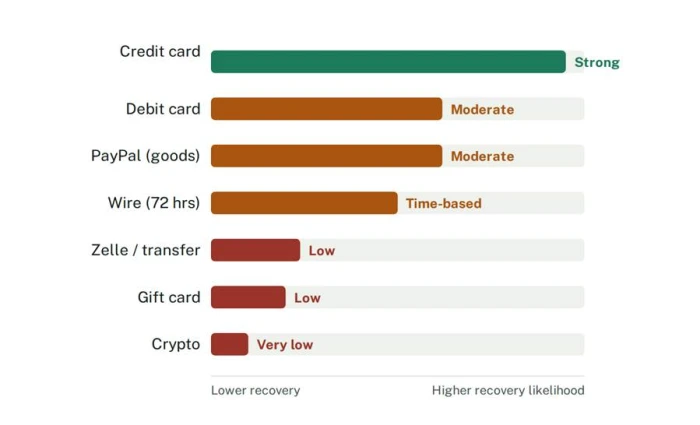
The pattern in one glance. Card payments and fast wire recalls sit at the recoverable end, while money sent by bank transfer, gift card, or crypto rarely comes back. Same loss, very different odds, decided mostly by the payment rail.
Scammed by a fake online store?
Fake storefronts are their own category, and the unsettling part is how ordinary they look now: polished product pages, real-looking tracking numbers, and social ads for genuinely desirable brands. The good news is they are far more beatable than a wire or crypto transfer, as long as the payment went on a card or PayPal. The trick is naming what actually happened and disputing it with the right words.
REAL CASE
The $99 sneaker deal that never shipped
• 490 reports to the BBB about fake HOKA shoe sales
• $99 for three pairs that normally cost $100-plus each
• 12 weeks of real-looking tracking before nothing arrived
In early 2024, the Better Business Bureau logged nearly 490 reports about fake sales of one hot item alone: HOKA running shoes. One came from a shopper in Sacramento who spotted a Facebook ad offering three pairs for $99, well under the $100-plus each pair normally costs. He ordered, received a real-looking tracking number, and only then noticed the parcel was shipping from China. The tracking even updated for weeks. Then, once it supposedly reached the US, the shoes never arrived and no refund came. Nearly every fake-HOKA report started the same way, on social media, and the storefront behind the ad is the part worth learning to read.
Signs the site was fake
• A hot item at a price no legitimate seller matches, sold by an unfamiliar store.
• The domain is brand-new, or a familiar brand name with an odd spelling or extension (.shop, .top, a country code that makes no sense).
• A search of the store name alongside "scam," "reviews," and "complaints" surfaces real problems fast, and a store with no off-site footprint at all is its own red flag.
• The only way to reach them is a contact form: no real address, no working phone, no monitored email.
• Checkout steers toward bank transfer, Zelle, crypto, or a payment page that feels off. These carry the least buyer protection.
• A confirmation and tracking number arrive, but the parcel ships from overseas and tracking never resolves to a real delivery.
• Reviews and testimonials live only on the site itself, easily lifted from real brands.

The address bar is evidence. Most fake stores give themselves away in the domain long before checkout.
• The real brand name is buried in the middle, not the domain. A genuine HOKA store lives on hoka.com, not inside a longer invented address.
• Filler words like "clearance," "outlet," "official," or "deals" are bolted on to borrow trust.
• Throwaway extensions such as .top, .shop, or .buzz are cheap to register and common in scam stores.
• The padlock only means the connection is encrypted, not that the seller is honest. Fake stores have padlocks too.
How to recover the money
1. Screenshot everything before the site vanishes. Fake stores disappear fast. Save the product page, order confirmation, receipts, emails, and the full URL.
2. Card payment? Dispute it as "item not received" or "not as described," not just "fraud." That is the wording Visa and Mastercard act on against a merchant that took the money and delivered nothing. A non-delivery claim generally has up to 120 days from the transaction.
3. PayPal goods and services? Open a Resolution Center dispute for an item not received. Friends-and-family sends are not covered, which is exactly why a fake store steering buyers there is a red flag.
4. Card entered on the checkout? Treat it as compromised. Contact the issuer to freeze or replace the card, since the number was likely captured for resale.
5. Report the site. File with the FTC at reportfraud.ftc.gov, add an IC3 report at ic3.gov if the card was stolen, and flag the domain to Google Safe Browsing to help get it taken down.
The reassuring half: even when a fake site is this convincing, paying by card turns it into a winnable dispute, because the loss is a service failure, goods that never arrived, which is exactly what chargeback rules were built for.
Authorized or unauthorized: the line banks care about
On that first call, the bank’s first decision is whether the transaction was unauthorized (someone used the card or account without permission) or authorized (the money was sent willingly, even though under deception). It sounds like a technicality. It is the whole game.
Unauthorized The charge was never approved. Strong legal protection applies under the Fair Credit Billing Act for credit cards and Regulation E for debit cards, and banks are generally required to investigate and refund. Examples: a stolen card number, an account takeover, or charges that were simply never made. | Authorized but deceived The payment was approved because a scammer engineered it. Federal law generally does not require a refund, so recovery leans on voluntary bank policies and on speed. Examples: most romance, investment, and imposter scams paid by Zelle, wire, or app. |
This is why the same $2,000 loss can be fully refunded on a credit card and nearly impossible to recover over Zelle. Politeness with persistence helps, and when the money moved by bank transfer, it is worth asking specifically whether an imposter-scam policy applies rather than accepting a blanket "the payment was authorized" denial.
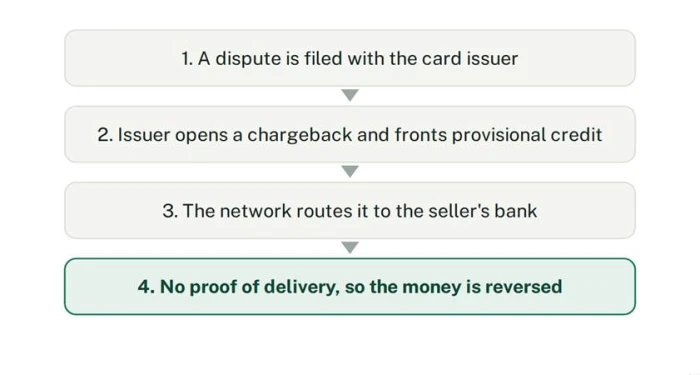
Why cards win. A chargeback runs on the card network’s own rules, not the seller’s goodwill, which is what turns a fake or non-delivering merchant into a winnable dispute. The window is usually up to 120 days from the transaction.
What to say on the call
Fraud lines run on scripts, so giving the representative the right language reaches the right team faster and frames the case correctly. Short and factual works best, with the relevant amounts and dates filled in.
Card or bank fraud line State that this is fraud: an unauthorized transaction for [amount] on [date] that was never approved. Request a dispute, a card freeze, and written confirmation of the dispute. |
Wire transfer Report a fraudulent wire transfer sent on [date] for [amount]. Request an immediate recall, contact with the receiving bank to freeze the funds, and a SWIFT recall. Note that a report is also going to the FBI IC3. |
Zelle or imposter scam Report an imposter scam that induced a payment of [amount] on [date], with the scammer posing as [a bank, a government agency, a company]. Request review under the imposter-scam reimbursement policy, not as a standard authorized transfer. |
A reference number and the representative’s name are worth getting on every call, along with everything in writing. If the first person says no, escalating to the fraud or claims department is the next step, together with asking whether the case was reviewed against the specific imposter-scam policy.
Wired the money? The clock runs 72 hours
Wire transfers feel final, and often they are, but there is a real government mechanism that has clawed back serious money when victims move fast. The FBI’s Internet Crime Complaint Center runs a Recovery Asset Team that can freeze fraudulent transfers through a process called the Financial Fraud Kill Chain.
The freeze works, but only inside the window
• ~3,900 emergency freezes the FBI team triggered in 2025
• $679 million frozen out of roughly $1.2 billion in attempted theft it could chase
• 72 hours the window before funds are split, moved overseas, or converted to crypto
The mechanism has traditionally focused on larger wires (around $50,000 and up) and international transfers with a SWIFT recall, but reporting is worthwhile regardless of the amount. The steps: contact the bank, use the exact phrase "fraudulent wire transfer," and file at ic3.gov the same day with the amount, date, receiving bank, and account number. Then request a Hold Harmless Letter or Letter of Indemnity from the bank to support the recall, and contact the local FBI field office in parallel so a person is on it faster.
The second scam: fake "recovery" services
Unsolicited offers to recover the money are another scam
This is the cruelest part of the whole ecosystem, and the most important to remember. The moment a loss is posted about or a report is filed, a second wave of scammers goes looking for the victim. They call themselves recovery agents, blockchain forensics experts, or lawyers, and they promise to get the money back for an upfront fee. The FBI has issued repeated warnings about this, including a 2025 alert about fake law firms impersonating real attorneys to target victims a second time.
• They made contact first, on social media, in comment sections, or by direct message.
• They ask for an upfront fee, a "release fee," or "taxes" before returning anything.
• They want payment in crypto or gift cards.
• They claim to work with the FBI, SEC, or a government agency. No agency authorizes private firms to recover funds for a fee.
• They guarantee results, or show glowing "success stories" from strangers.
The rule is simple: unsolicited contact means do not pay. Real investigators never charge victims, and legitimate lawyers do not cold-message people promising a guaranteed recovery.
Where to report, and why it still matters
Even when the money is gone, reporting is not a formality. Reports feed the databases that trigger investigations, freezes, and refund programs, and a documented report is often exactly what a bank needs to process a claim.
Federal Trade Commission reportfraud.ftc.gov / 877-382-4357 The central US fraud database, shared with more than 2,000 law enforcement agencies. | FBI IC3 ic3.gov For internet crime, wire fraud, and crypto. Include every available transaction detail. |
The bank or card issuer The number on the card The only party that can actually reverse a payment or freeze an account. | State Attorney General The state consumer office Some states pursue cases that federal agencies drop, including recent Zelle actions. |
CFPB consumerfinance.gov For complaints about how a bank handled or refused a fraud claim. | Elder Fraud Hotline 833-372-8311 Free help filing reports for anyone aged 60 or older. |
The scale of it (and why fast reporting works)
Feeling foolish is the wrong instinct here. This is mass-industrial crime, and the numbers are staggering. Every victim is one of millions, which is exactly why fast, precise reports matter: the details help connect the dots that take these operations down.
$15.9B reported lost to fraud in the US in 2025, up from $12.5B in 2024 (FTC) | 1M+ imposter-scam reports, the most reported fraud type (FTC) |
$7.9B lost to investment scams, the single largest category (FTC) | $217M lost to gift card scams in 2024 (FTC) |
The honest bottom line
After thousands of these cases, one pattern holds. Recovery is real, but it is not the norm, and almost everything hinges on the first hour. The victims who get their money back are rarely the ones with the strongest case. They are the ones who called the bank before the shock had worn off, used the right words, and filed the reports the same day.
When a scam has just happened, the move is to make the call now. Follow the order at the top of this guide, stay polite and persistent, and get everything in writing. Money that traveled by credit card or a fast wire recall has genuinely decent odds. Money sent by gift card, Zelle, or crypto calls for tempered expectations but still warrants action, because a filed report is what protects the next person and occasionally brings a freeze in time.
Going forward, the cheapest protection is a habit. Before a purchase from an unfamiliar store, running its address through a site-safety scanner like Sitescano flags the obvious fakes before any card details are entered. Thirty seconds up front beats a chargeback later.
And whatever happens, anyone who slides into the inbox promising to get it all back for a fee should be ignored. That is not recovery. That is the sequel to the scam. The only names worth trusting are the bank, the FTC, and the FBI, and not one of them will ever charge for help.